|
|
|
|
Additional information taken from Southwark's Burial Places by kind permission of author Mr Ron Woollacott. |
|
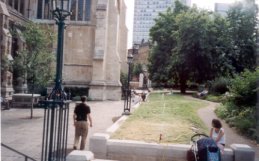
St. Saviour's Churchyard. Southwark Cathedral from1905. Churchyard to S. now paved and much truncated. Rocque and Horwood suggest an extensive churchyard to the north of the church, (priory cloister?) now lost. In November of 1822 the funeral of a Southwark milkman took place here; he had committed suicide after being fined and bound over to keep the peace. This was, it seems, the result of a quarrel with his wife. The milkman had been popular and respected by his neighbours, but there was little sympathy for his wife, who was forced to observe the funeral from her window. (The Times, November 5th 1822) Famous burials within and without include poet John Gower (d 1408) Lancelot Andrewes, Bishop of Winchester (d 1626) Edmund Shakespeare (William's brother. d. 1607). This ancient ground has been often enlarged and curtailed, and at times was used as a market-place. What now exists is about 1 acre on the south side of the church, which is at present under restoration. (Holmes) ST. SAVIOUR'S CHURCH, Southwark. The burial ground adjoining the church is very full. There are two vaults belonging to this church, one called the Great Vault, underneath the. body of the church. The coffins are piled one upon another; some, which contain branches of the same family, are chained together. All the bodies placed in this vault are buried in lead,-a condition never deviated from. When this vault is opened a fire is always kept burning. On one occasion I accompanied the grave digger to this vault; he received a caution from the sextoness, and hesitated for some time before opening the door; he observed that " he should know, directly he opened the place, whether there was danger." In descending, he carried a lighted candle at arm's-length; he then called out, "there is no danger." The place is extremely damp, and gives out a most offensive smell. Another
vault, called the Bishop's vault, runs underneath the church yard. Light
and air are admitted from the burial ground, through an iron grating.
The entrance to this vault is through the " Ladye Chapel ;"
the roof is arched over with brick-work. The coffins are piled upon one
another, but the burying in lead is left to the option of the party
concerned in the funeral; the smell here is more offensive than in the
larger vault. |
|
|
|
|
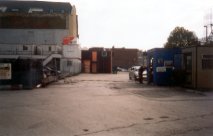
Additional ground for St. Saviour’s, called the College Yard or St. Saviour's Almshouse Burial-ground, Park Street. Opened about 1730. Purchased in 1860 by Charing Cross Railway Co. and railway arches were built over the ground. Human remains moved to Brookwood cemetery Woking. Other bodies reburied at Nunhead cemetery. The remainder of the ground was roofed over and used as a builder's yard as described by Mrs Holmes. Now part of the Borough Market. This existed before 1732. Size, ¼ acre. The London, Brighton and South Coast Railway goes over it on arches, and it is now the storeyard of Messrs. Stone and Humphries, builders. Most of it is roofed in but it is not actually covered with buildings. (Holmes) |
|
|
|
|
|
|
|
Additional ground for St Saviour's, called the Cross Bones. Redcross Street. (Now Redcross Way) Very old ground, originally unconsecrated and used for the burial of prostitutes from the South Bank 'stews'. Later used for Pauper burials. Notorious for body-snatching, given the presence of St Thomas's and Guy's hospitals nearby. A high wall with broken class on the top was built in the early nineteenth century, but (allegedly) the sexton was in league with the body snatchers so this was ineffective. Building work in the 1920s led to the exhumation of many bones, as did building work on the new substation for the Jubilee Line extension in the 1990s. Detailed archaeological work from this time and a general history of the ground is described in The Cross Bones Burial Ground (Museum of London Archaeological Service 1999). Currently the site is derelict. It is owned by Network Rail who wish to use it for offices. There is a local campaign to create an amenity open space here. 2013 - read Paul Slade's excellent book, The Outcast Dead - Cross Bones Graveyard. Details at www.planetslade.com/cross-bones.html. This was made, at least 250 years ago, "far from the parish church," for the interment of the low women who frequented the neighbourhood. It was subsequently used as the pauper ground, and was crowded to excess. Nevertheless two schools were built in it. The remaining piece is about 1,000 square yards, It has frequently been offered for sale as a building site, and has formed the subject for much litigation. It is made partial use of by being let for fairs, swings, &c. It was sold as building site in 1883, but, not having been used by 1884 the sale was declared (under the Disused Burial Grounds Act) null and void. (Holmes) The poor ground, called “Cross Bones,” in Red Cross Street, Union Street, Borough, also belongs to this parish. The greater portion of this ground has not been opened for some time past, in consequence of its very crowded state; the remaining part, however, is still used for interments, many of the poor Irish are buried in it. Two charity schools, one for boys and the other for girls, are built at the west end, in Union Street, the back parts of which run into this ground. On the 20th February last, a vestry meeting was holden "for the purpose of considering the propriety of re-opening the Cross Bones burying ground. "The ground had been closed about two years (the time generally allowed for the destruction of the bodies! ) and it was moved that it be re-opened; the mover of the resolution stating, that in consequence of the aversion generally manifested to bury in what is named the " Irish corner," many bodies were taken out of the parish to be buried. This corner, however, had been cleared, and room made for about a thousand bodies. One gentleman argued that " if the graves had been made deeper, hundreds more corpses might have been buried there." Another admitted that it really was too bad to bury within eighteen inches of the surface, in such a crowded neighbourhood; and it was even hinted that " the clearing," viz. the digging up and the removal of the decayed fragments of flesh and bones, with the pieces of coffin, &c. would be the best course, were it not for the additional expense." The fund of the vestry and the health of the living were here placed in opposite scales: the former had its preponderance. (Walker, 1839) |
|
|
|
|
|
|
|
|
Cross
Bones ground today
|
|
Deadman’s Place Burial-ground. Now Southwark Bridge Village Car Park, off Thrale Street. Behind the Novotel and Southwark Rose Hotel. Car Park Motto; 'Thank you for calling - please call again!'. This probably wouldn't have worked in Walker's Day. Its history is obscure. Some historians claim it dates from at least Elizabethan times, and has been in use as a burial place for plague victims for centuries. Others say it was established later, as a non-conformist ground. Burial place of Alexander Cruden, author of the Biblical Concordance. The name is probably nothing to do with the presence of the burial ground. Deadman's Place is now called Park Street. This ground was originally used for the interment of large numbers of victims to the plague. Then it became the graveyard of an adjoining Independent chapel, and was extensively used for the interment of ministers, being a sort of Bunhill Fields for South London. Now it is merely one of the yards over which trucks run on rails, in the middle of the large brewery belonging to Messrs. Barclay and Perkins, about ½ acre in extent. It existed as a burial-ground in 1839, but not, I believe, in 1843. (Holmes) DEADMAN'S PLACE.- This burying ground is near to Ewer Street, and is equally surcharged with dead, - the name befits the appearance. Tradition says it took its name from the number of the dead interred there in the great plague, soon after the Restoration. (Walker, 1839) |
|
|
|
|
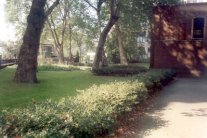
Christ Church Churchyard, Blackfriars Bridge Road. Probably earlier than Holmes suggests below: Woollacott gives 1671 as date of first burial. Church consecrated 1671, rebuilt 1741, graveyard extended at that time and again in 1817. Ground closed 1856. Opened as a public garden in 1900. Church destroyed in WW2, rebuilt 1960 as an uninspiring brick box. The churchyard is quite attractively laid out. In March of 1818 the bodies of three adults and a child were 'torn from their graves' by body Snatchers, the wall around the ground being 'too low and defective for the purposes of security' (The Times March 20th 1818) Crypt cleared 1895 when it was discovered that lead coffins were being melted by the heat from the newly installed boilers. 650 bodies removed to Brookwood. This dates from about 1737, and has been enlarged. An infant school was built in it. It is closed, and not laid out. (Holmes) |
|
|
|
|
|
|
|
|
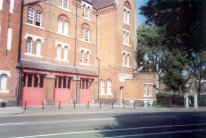
Lost Grounds Baptist Burial-ground, Bandy Leg Walk (Now Southwark Bridge Rd) St Saviour's Workhouse Ground Still a fire station. In 1988 Skeletons were found when laying pipes in the fire station car park. The St Saviour's workhouse ground was adjacent and to the east of the Baptist ground. It was formed in 1777 as a poor ground. Remains found in 1884 on construction of the fire station; site now lost under Southwark Bridge Road. The site was originally part of the unsuccessful Grotto Gardens Pleasure Ground founded 1760 and remembered today by Grotto Court. Subsequently called Guildford Street. There was such a ground in 1729. In 1807 there existed the St. Saviour's Workhouse, with a burial ground on the east side of it which, from its position, may have coincided with the Baptists' ground, and what is now left of the burial-ground is a garden or courtyard, about 1,000 square yards in size, between the new buildings of the Central Fire Brigade Station in Southwark Bridge Road, and the old house behind them. It is entered through the large archway. (Holmes) |
|
|
|
|
|
Friends' Burial -ground, Worcester Street (Now
O'Meara Street.)
|
|
|
|
|
Chapel Burial-ground, Ewer Street W. side of Ewer St., where the railway crosses the road. Known in the 1820s as Crawford's ground, although owned at that time by an undertaker named Wild. Removed c1861 when the Charing Cross Railway was built, though judging by recent finds many bodies were left in situ. Date of the discovery of bodies mentioned below was actually June 1987. At
a late hour on Wednesday night, the neighbourhood of Ewer Street, In the
Borough, was thrown into great confusion by the report that an attempt
had been made by two of that by now very numerous body called 'bodysnatchers'
to disinter the body of a child at Crawford's private burial ground in
that street.
|
|
|
|
|
| Baptist Chapel Ground, Pepper Street
(Duke Street Park)
The chapel is shown on Rocque. Probably now under the widened Union Street. Houses at corner of Pepper Street are on the site. (Holmes) |
|
St. Margaret, Southwark Parish church of Southwark until 1541. Burial ground extended in 1536. Site of church sold in 1545. Apparently the churchyard was extremely crowded. Church converted to a prison in later years, then replaced by the town hall. The ground disturbed during building work in 1832 and large quantities of human remains were found. The site is now occupied by Town Hall Chambers, Borough High Street, and by the widened Southwark High Street. |
|
|
|
|
| Unknown
ground Knight, in London Vol 4. (1841), quotes the following: 'Martin's, in the Borough, measuring about 295 feet by 379, is supposed to have received within ten years 14,000 bodies' This is the only reference I can find to 'Martin's Ground' though Hoole and Martin were the proprietors of New Bunhill Fields in the New Kent Rd. Knight cannot be referring to this ground as he mentions it as well. One possibility is that it refers to the ground in Ewer St. mentioned above - the dimensions seem to fit quite well. This ground was in private ownership by the 1830s. |
|